Finding value
in today's
commodity cycle
September 2026
Macroeconomic forces and commodity-specific drivers have combined to fuel a strong commodity upcycle over the past year, shining a light on traditional value-oriented sectors like Energy and Materials. The current environment provides an opportunity for active managers to outperform based on selecting companies with the strongest combination of valuation, fundamentals, and earnings momentum. In our view, healthy companies that exercise capital discipline and do not rely on peak-cycle prices for profitability are best positioned to generate large amounts of free cash flow and benefit from the windfalls of higher commodity prices.
What is driving the commodity cycle?
There are several macroeconomic drivers pushing commodities prices higher. The fi rst is geopolitics: a reordering of global trade, the return of armed conflict, and new central bank reserve management behaviors. Reshoring, re-industrialization, and remilitarization all create commodity demand, while conflicts like the Iran war and Russia’s invasion of Ukraine create supply shocks. The second is the macro backdrop. Structurally higher fiscal deficits and persistently higher inflation relative to the post-Global Financial Crisis period are driving demand for real assets. And third, the AI infrastructure buildout drives demand for commodities like copper and silver that are crucial to electrification.
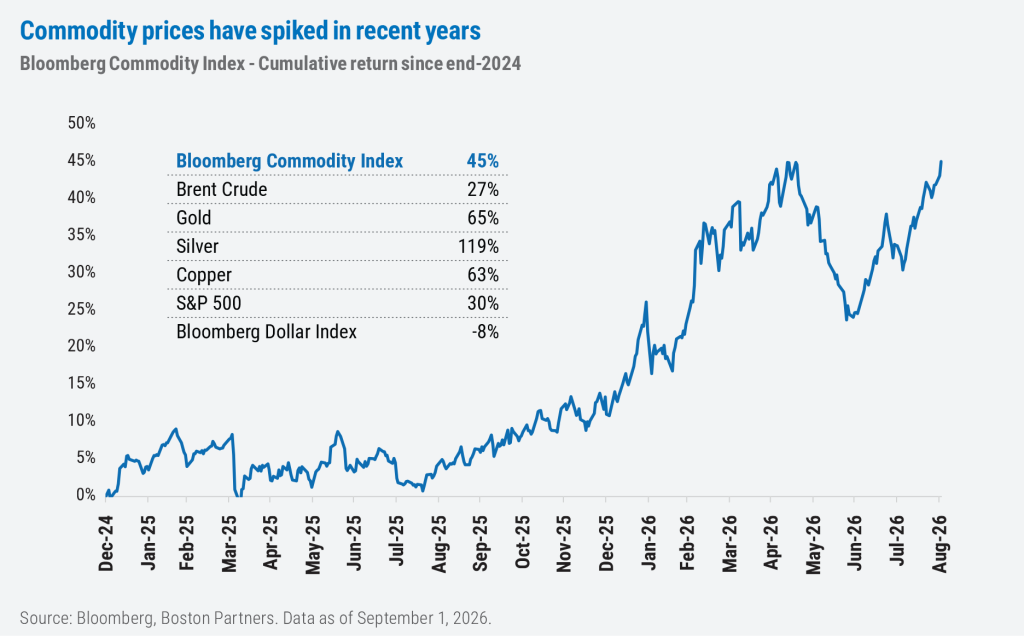
The above, along with other individual sector-driven tailwinds, have driven gains in commodity-linked sectors like Energy and Materials, and create an opportunity set for active managers. Three areas that exemplify this dynamic are oil/energy, gold, and copper.
Oil / Energy
For oil and the broader energy complex, 2026 has been a story of supply shocks driven by geopolitics. Many analysts started the year worried about downside risks to oil prices from a potential supply glut (OPEC+ spare capacity coupled with expectations that non-OPEC+ countries like Brazil and Guyana would increase production).
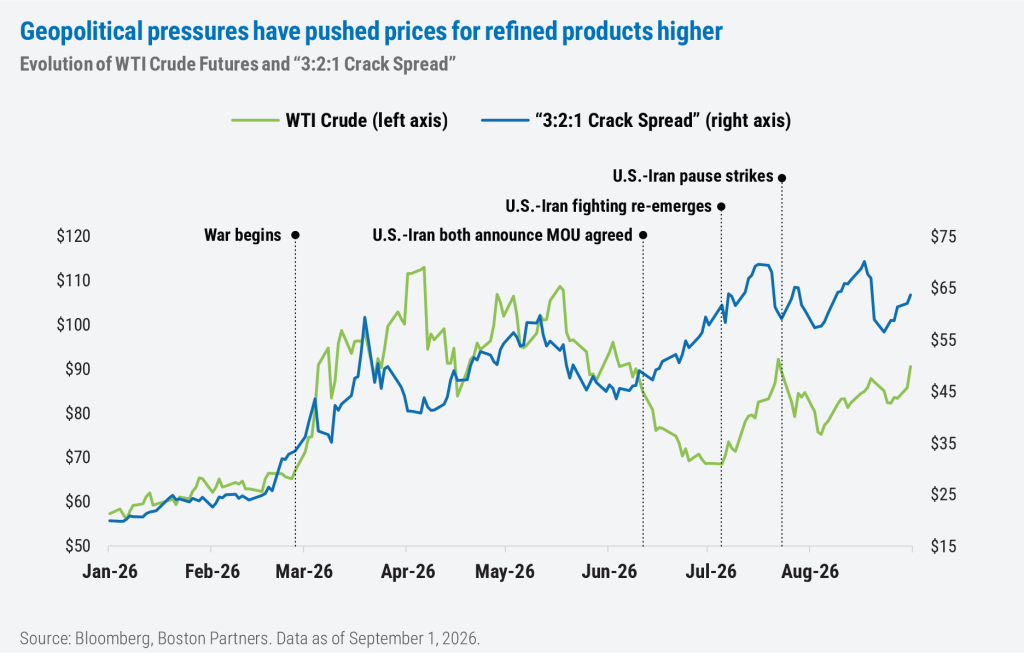
Those concerns changed quickly with the onset of the Iran war, which saw the closing of the Strait of Hormuz and what many analysts have called the largest oil supply shock on record. Brent and WTI crude oil prices rose above $120/bbl and $110/bbl, respectively, in immediate response to the closing of the Strait. Oil prices have since fluctuated widely, driven by a variety of factors, including on-again/off-again peace negotiations, redirection of Persian Gulf oil flows, “dark fleet” tankers still transiting through the Strait, increased production from non-Gulf producers, and demand switching (most notably from China).
While oil prices dominate headlines, oil products (e.g., gasoline, diesel, jet fuel) are experiencing even sharper impacts (commonly referred to as higher “crack spreads”), not only from the disruptions caused by the Iran war but also from Ukraine’s targeting of Russian oil refineries as it looks to gain leverage in that war. As long as these conflicts persist and uncertainty remains, there is likely to be a risk premium in energy commodities.
Where we see opportunities today
Energy sub-sectors have different drivers. Upstream producers are correlated with oil prices, refiners are more closely tied to the oil products markets, and services are tied more to the maintenance and building of new oil production and refining facilities, for example.
One positive development that cuts across the sector is related to capital discipline. For many years, energy companies were quick to ramp up capital spending and increase production to take advantage of energy price spikes, only to fall on hard times when prices fell. But especially during this decade, investors have instilled the importance of discipline on the sector, transforming it into a value sector that generates strong capital returns.
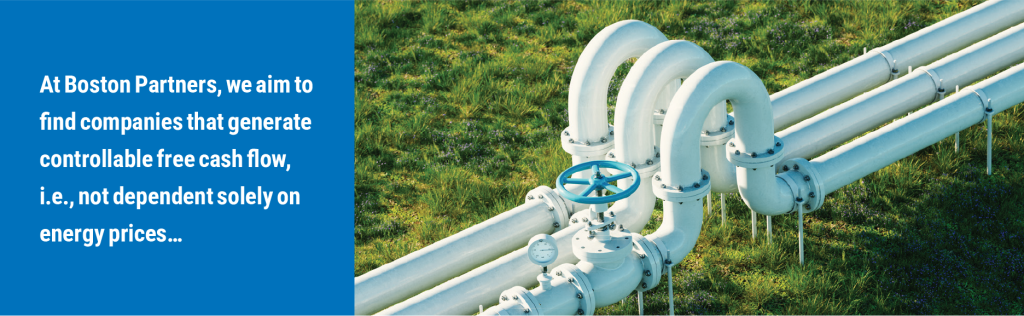
Today, energy companies best positioned to generate substantial free cash fl ow when energy commodities trend higher are those that have shown restraint in capital spending, have developed healthy balance sheets, and are profitable even on conservative estimates of oil prices. Of course, active managers have the opportunity to be even more selective, choosing those that are showing other signs of business momentum like better efficiency in production or unlocking asset value via strong execution on high-return projects, for example. At Boston Partners, we aim to find companies that generate controllable free cash flow, i.e., not dependent solely on energy prices for us to take advantage of a strong opportunity set in an environment of high volatility for the underlying commodity price.
The points of emphasis within the energy sub-sectors are likely to fluctuate over time. Refiners have gained sharply since the war began, on unusually wide crack spreads. But those gains have pushed valuations to levels that only hold up if midcycle margins are structurally higher moving forward. Companies levered to the price of oil have also done well, and stand to gain more if oil gets bid up by refiners increasing refining runs on spare capacity as the market works to compress crack spreads. Services companies, whose fortunes track new project activity, become interesting if producers eventually relax capital discipline and spend to capture persistently high prices.
Gold
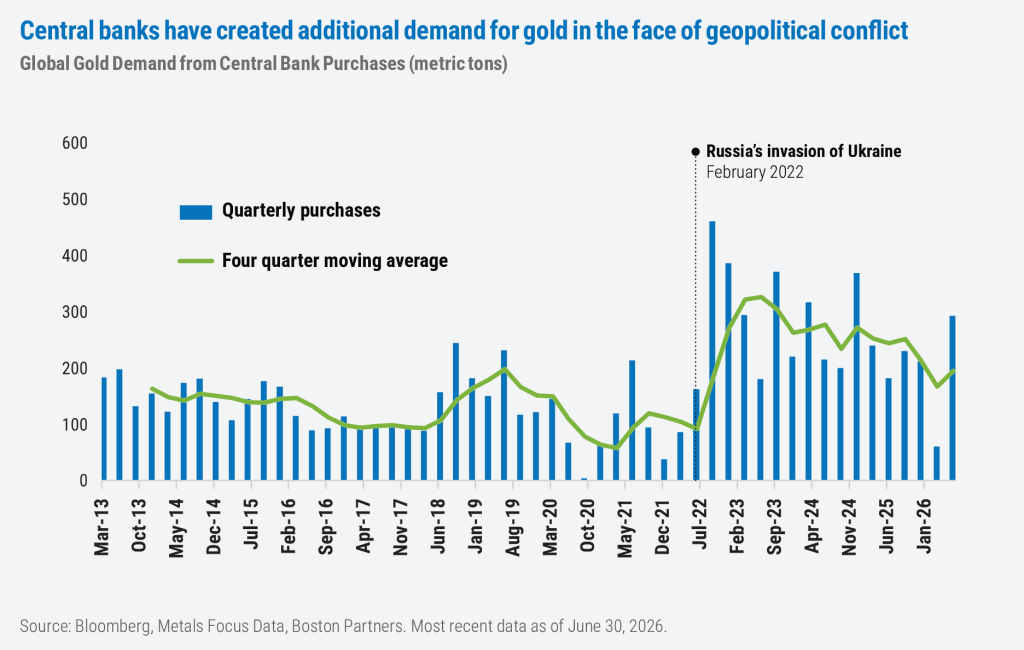
Gold has been a story about shifting drivers of marginal demand. Historically, gold prices have been inversely correlated to real interest rates—higher real rates increase the opportunity cost of holding a non-interest-bearing asset like gold. That relationship broke down for a time beginning in 2022 after Russia’s invasion of Ukraine. In response, Western democracies froze Russian sovereign assets, and global central banks became a marginal buyer of gold as they sought to diversify reserves. The old correlation re-emerged in 2025, as expectations for rate cuts and concerns about Fed independence/fiscal deficits/inflation added fuel to the gold rally. For most of 2026, expectations of higher rates due to the Iran war and hopes that new Fed Chair Kevin Warsh would clamp down on inflation were headwinds to gold.
While there are strong arguments on both sides for where gold goes from here, many analysts are bullish on gold longer-term, at least at levels that would continue to allow miners to be profitable and continue to improve their businesses. There is likely some floor provided by the new structural demand from central banks and ongoing cycles of concern about inflation and fiscal spending.
The opportunity set in gold miners
Gold miners have historically been a difficult investment, leading to the kind of market skepticism that often creates opportunities for value investors. Miners are highly capital-intensive businesses that need to spend persistently to maintain their existing production. Operating costs have historically inflated over time (e.g., labor, energy, consumables, and royalties that trend higher alongside gold prices) and tend to be sticky—so miners historically have seen stark margin compression when gold prices come down.
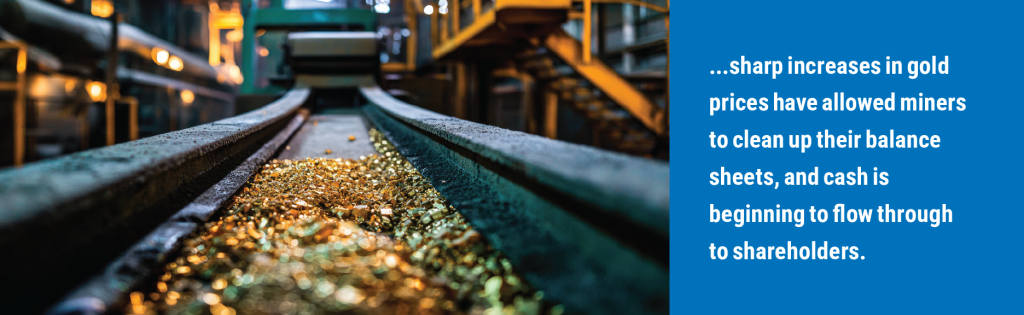
In terms of valuation, the market continues to price many gold miners as perennial destroyers of capital. We regularly see companies trading at discounts to net asset value not only at prevailing gold prices near $4,500/troy ounce but also well below that level. And while the fundamentals of these businesses will likely always remain difficult due to the structural forces mentioned above, much higher gold prices have led the financial characteristics of the sector to improve in ways we can measure. For example, the sharp increases in gold prices have allowed miners to clean up their balance sheets, and cash is beginning to flow through to shareholders.
Similar to the opportunity set in energy, we look for miners that are disciplined from a capital allocation perspective and do not depend solely on peak-cycle prices—businesses that can grow production and free cash fl ow per share idiosyncratically. We also monitor business momentum to confirm the improvement is real and persistent; rising earnings revisions and improving returns separate improving businesses from ones that are simply cheap. We see opportunities in gold miners that exhibit these characteristics today.
Copper
While the oil story has been mostly about supply and the gold story mostly about demand, copper prices have risen sharply due to both. On the demand side, copper is a critical input in the electrification process, and therefore the AI buildout (not necessarily the data centers themselves, but the electrification needed for supporting infrastructure). The sharp increases in global electric vehicle and solar panel production are also fueling demand. Meanwhile, many analysts are predicting the copper market will move deeper into deficit as this higher demand meets difficult supply issues, including long lead times to build new mines, geopolitical and operational disruption, a lack of new copper discoveries, a decline in ore grades (i.e. the percentage of copper found in a rock that is mined and processed), and inventory distortions caused by tariffs.
The opportunity set in copper miners
Tight supply/demand conditions are presenting opportunities for copper miners to reinvest at a high level of return, supported largely by internally generated cash from operations. Resource scarcity within copper is high, while the assets themselves are structurally different than in gold; whereas gold mines may carry 10-15 years of reserves (forcing perpetual reinvestment), large copper deposits can operate for decades. Naturally, these sorts of projects come with large amounts of operational risk, though once delivered, they can produce significant cash flows. Given operational risks, we monitor momentum to look to protect downside (structural issues within mining tend to be persistent), while looking for companies with a history of strong execution.
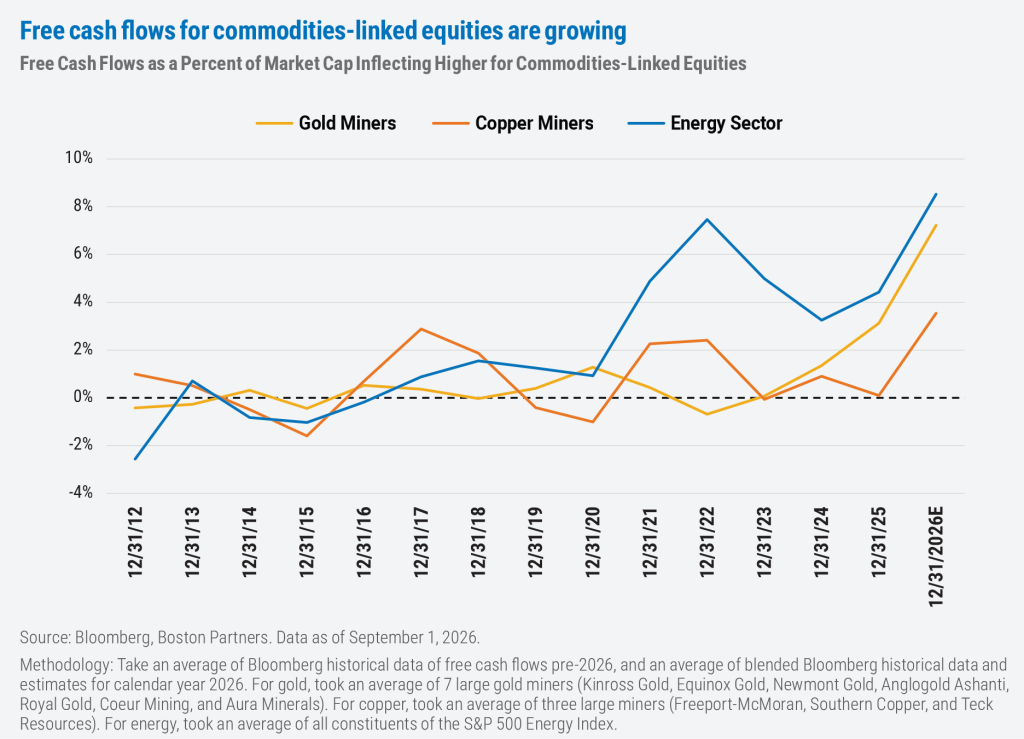
Ultimately, we use the same framework when evaluating miners of both metals: We are looking for attractively valued businesses with improving fundamentals and positive momentum. In metals more broadly, we view the opportunity set as attractive and supported by macro/geopolitical factors, while from a bottom up basis, the miners are generating healthy cash flows with opportunities to either reinvest or return cash to shareholders.
Important information
The views expressed in this commentary reflect those of the author as of the date of this commentary. Any such views are subject to change at any time based on market and other conditions and Boston Partners disclaims any responsibility to update such views. Past performance is not an indication of future results.
Discussions of securities, market returns, and trends are not intended to be a forecast of future events or returns. You should not assume that investments in the securities identified and discussed were or will be profitable.
OPEC + refers to an alliance of oil-producing nations: the 12 core Organization of the Petroleum Exporting Countries, plus 10 non-OPEC partner countries. Brent Crude and West Texas intermediate (WTI) are the world’s two main benchmarks for setting oil prices, with Brent serving as the international standard and WTI representing the U.S. market. Crack spreads refers to the price difference between crude oil and the refined petroleum products made from it. Beta is a widely used indicator of an assets price volatility relative to the broader market. Real interest rates are stated interest rates adjusted to remove the effects of inflation. The S&P 500 Energy Index is a capitalization-weighted stock market index that tracks the performance of energy sector companies within the S&P 500. Dark fleet tankers refers to ships that move oil and gas while hiding their real location, ownership, and cargo to avoid international sanctions.
Boston Partners Global Investors, Inc. (Boston Partners) is composed of three divisions, Boston Partners, Boston Partners Private Wealth, and Weiss, Peck & Greer (WPG) Partners, and is an indirect, wholly owned subsidiary of ORIX Corporation of Japan (ORIX).
9119994.1
International Equity
A strategy seeking attractively priced opportunities outside the United States.
International Select
A concentrated portfolio of our highest-conviction international opportunities.