Boston Partners Long/Short Equity Fund (BPLSX)
After three consecutive years of double-digit returns from the S&P 500 Index, history suggests heightened volatility may lie ahead. With many investors heavily exposed to just a handful of stocks, now’s the time to examine how long/short strategies can help mitigate today’s equity-market risks.
Three reasons to consider a long/short strategy:
Combining long and short positions in a single diversified portfolio can help reduce volatility and potentially lead to higher compound returns.
When the stock market sells off, short positions generally appreciate, which can add ballast to a portfolio, helping to mitigate drawdowns and potentially improve risk-adjusted returns.
Short positions don’t only act as a hedge, they also represent a unique and uncorrelated source of alpha with the potential to generate positive returns in choppy or down markets.
Why Boston Partners Long/Short Equity Fund?
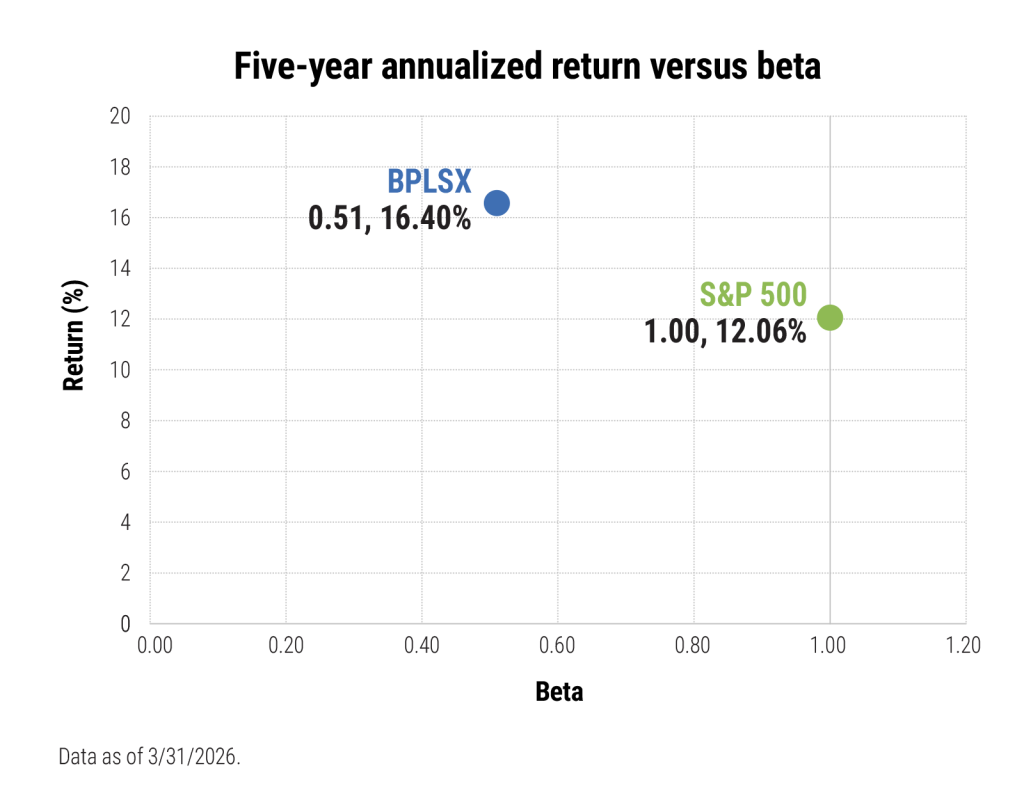
1. Focused on capital appreciation while seeking to limit exposure to equity mark risk
Since its inception in 1998, the Boston Partners Long/Short Equity Fund (BPLSX) has employed the same disciplined approach, targeting undervalued stocks with strong business fundamentals and positive business momentum, alongside a diversified short portfolio of stocks that do not meet these characteristics.
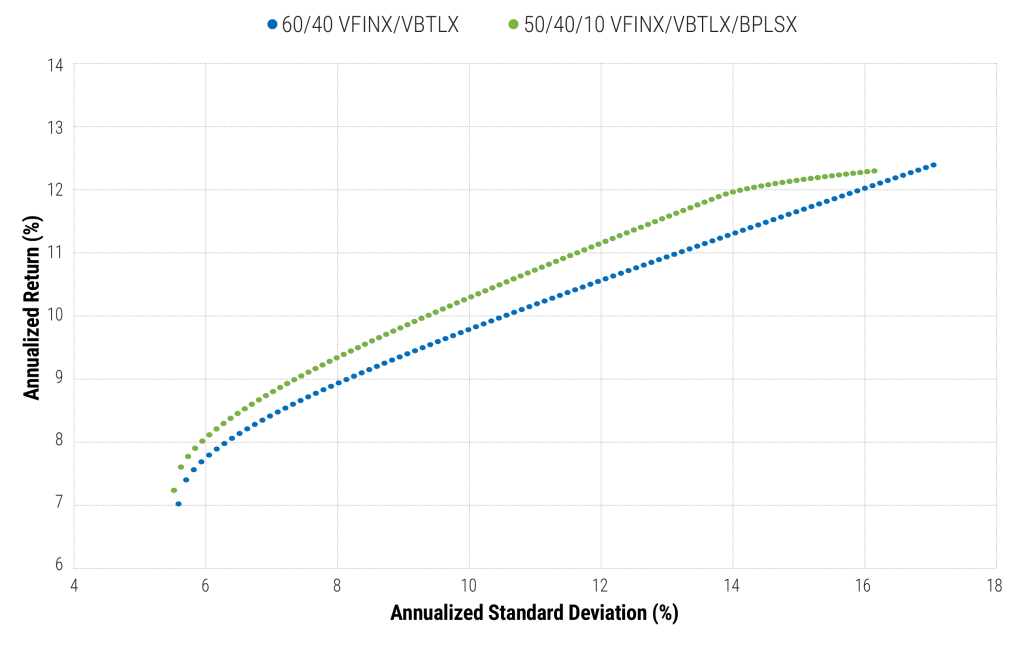
2. Potential to improve diversification of a balanced portfolio
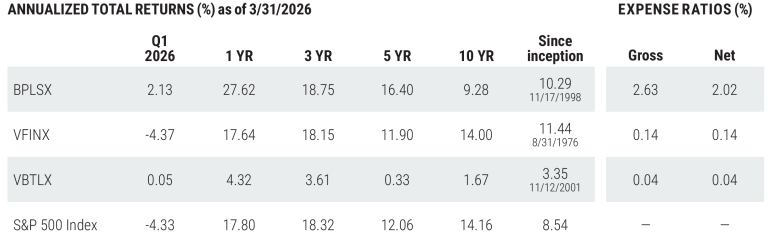
A 10% hypothetical allocation helped improve risk-adjusted returns of a 60%/40% portfolio.
Source: Morningstar as of December 31, 2025. Fund performance is net of fees since inception of the earliest common inception date (11/12/2001).
The illustration reflects a hypothetical 60%/40% balanced allocation using VFINX and VBTLX as proxies for stocks and bonds, respectively, compared with a hypothetical 50%/40%/10% balanced allocation using VFINX, VBTLX, and BPLSX, respectively. The hypothetical portfolios assume periodic rebalancing and the reinvestment of income and capital gains. This information does not represent the actual performance of any investor account or portfolio. Results are hypothetical and do not reflect actual trading, taxes, transaction costs, customized investment restrictions, cash flows, or other client-specific factors, all of which may materially impact performance. Hypothetical performance has inherent limitations, and there can be no assurance that any investment will achieve results similar to those shown. Past performance is not a guarantee of future results. The Vanguard 500 Index Fund (VFINX) seeks to track the performance of a benchmark index that measures the investment return of large-capitalization stocks. The Vanguard Total Bond Market Index Fund (VBTLX) seeks to track the performance of a broad, market-weighted bond index.
The performance data quoted represents past performance and does not guarantee future results. Returns for periods less than one year are cumulative. Current performance may be lower or higher. Performance data current to the most recent month-end for BPLSX may be obtained here. The investment return and principal value of an investment will fluctuate so that shares, when redeemed, may be worth more or less than their original cost. The Fund’s Advisor has contractually agreed to waive all or a portion of the advisory fee and/or reimburse certain expenses in excess of 2.21% (investor class) and 1.96% (institutional class) of averaged daily net assets. The contractual limitation is in effect until 12/31/2026. If fee waivers and reimbursements had not been included, performance would have been lower. Net expenses are as of the most recent prospectus.
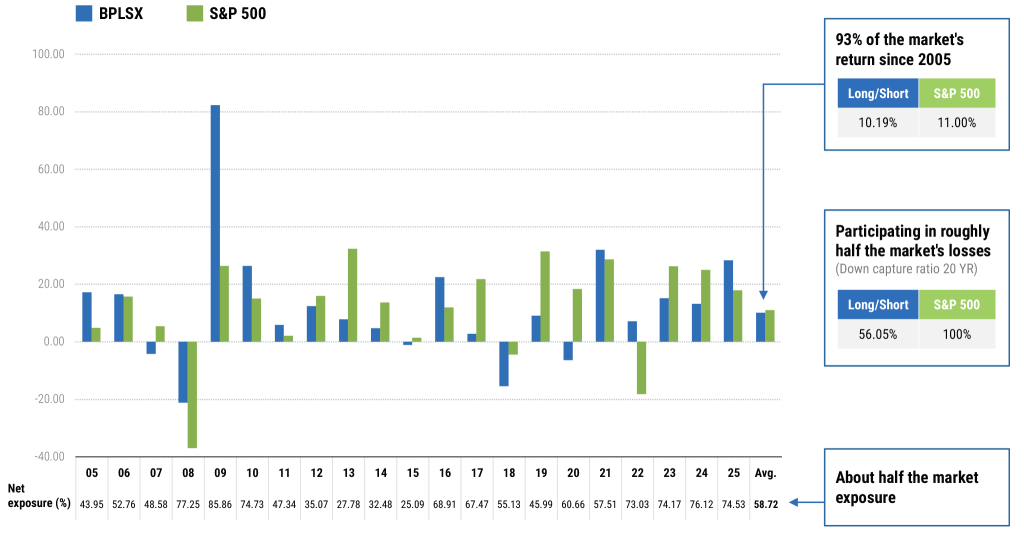
3. Adding a source of alpha, particularly in challenging markets.
CALENDAR YEAR RETURNS SINCE 2005 (%) as of 12/31/2025
Explore additional resources on long/short investing
How long/short investing can turn into a positive turblent markets
With volatility back in play and concentration risk still a major challenge, investors may want to consider making a long/short strategy a dedicated part of their portfolios.
Boston Partners Long/Short Equity Fund factsheet
This piece offers details about the fund’s performance, portfolio allocation, and top holdings. Updated quarterly.
Complete fund performance
A deeper dive into Boston Partners' process
In this overview, Portfolio Analyst Brandon Smith reviews how long/short portfolios work, what to look for in selecting a manager, and why they’re attractive in today’s market.
For more information on any of our long/short strategies or how they can work in a portfolio, please contact us with the form below.
Important disclosures
Investment Risk:
Investing involves risk, including the potential loss of principal. International investing is subject to fluctuations in currency exchange rates; political, social, or economic instability; and differences in taxation, auditing, and other financial practices. Investing in emerging-market securities may increase these risks. Foreign investors may have taxes withheld. Small- and mid-cap companies tend to be more volatile and may fluctuate in value more than the broader stock market. Illiquid securities may be difficult to value or to sell. Investments in undervalued or out of favor stocks may not appreciate and could decline further. Short sales involve the potential for significant losses and can disproportionately affect the value of the portfolio. Higher rates of portfolio turnover may result in higher costs and capital gains. Options and derivatives may be more sensitive to changes in market conditions.
Important definitions:
Active share measures the percentage of a stock portfolio that differs from its benchmark. Alpha measures the excess risk-adjusted return of a portfolio relative to a benchmark index. Beta is a measure of a portfolio’s market risk relative to its benchmark. In general, a beta higher than 1.00 indicates a more volatile portfolio and beta lower than 1.00 indicates a less volatile portfolio in relation to its benchmark. Downside capture measures a portfolio’s performance in down markets relative to the index. A value below 100 indicates that a fund has outperformed in down markets. The figures shown are for the trailing five years. Price/earnings (P/E) ratio measures a company’s current share price compared to its per-share earnings. Forward P/E uses a company’s forecasted earnings for the next year. The fund’s benchmark is the S&P 500 Index, which tracks the performance of the 500 largest companies traded in the United States.
You should consider the investment objectives, risks, charges and expenses of Boston Partners Investment Funds carefully before investing. Call (888) 261–4073 to obtain a prospectus with this and other information about the Funds. It should be read carefully before investing.
Quasar Distributors, LLC is the distributor of the Fund and is not affiliated with Boston Partners.

8740422.1